
Summer Lightning (Hopback) Brewing Journal
Started 23/08/14
This brew was planned using the Beer Engine software to make a 2 Corny batch.
Recipe
Ingredients:
| Recipe | Measure | |
|---|---|---|
| Pale Malt (EBC 4 or less) | 8244g |
 |
| Challenger Hops (start of Boil) | 76g | |
| Goldings Hops (Last 10 Min of Boil) | 24g | |
| Goldings Hops (End of Boil) | 14g | |
| Yeast | S-04 X 2 | |
| Mash Liquor | 21 Litres | |
| Strike Heat | 72C | |
| Mash Temperature | 66C | |
| Mash Time | 1 Hour 30 Minutes | |
| Sparge Temperature | 77C | |
| Mash Efficiency (estimated) | 75% | |
| Boil Time | 1 Hour 30 Minutes | |
| Batch Volume | 38 Litres | |
| Fermentation Temperature | 20C | |
| Expected OG | 1049 | |
| Actual OG | 1045 | |
| Expected FG | 1012 | |
| Actual FG | 1010 |
Water Treatment:
| Recipe | Measure |
|---|---|
| CaCo3 Adjustments | |
| Calcium Carbonate (CAC03) Anglian - Measured with Salifert Kit | 154 ppm |
| Calcium Carbonate Required | 30 ppm |
| Adjustment Necessary | 124 ppm |
| CRS per Litre Required | 0.5 ml/L |
| Total CRS to add to Mash (21L) | 10 ml |
| Total CRS to add to Sparge- Can Only got 28L in HLT | 14 ml |
| Chlorine Treatment | |
| Campden Tablets (half in mash, half in sparge) |
1 tablet |
| Calcium Adjustment (using brupaks calculation) | |
| Calcium in Water | 62 ppm |
| Calcium Required | 180 ppm |
| Adjustment | 118 ppm |
| DLS (using GW Calc it suggests adding none) | No DLS available so not added |
Anglian water seems to have changed dramatically in my area over the last year. At time we have had a caco3 reading of 230 but it is now down to 154. This has caught me out as I do not have any DLS and could have done with raising the Calcium levels. However, the impact should not be big enough to prevent me brewing.
Mashing:
- The night before my brew day, I added 21l of water to my HLT. The water was treated with 10ml of CLS and 1/2 a Campden tablet, then left overnight.
- The Mash water (liquor) has taken 1 hour to get to 78C.
- After transferring to the mash tun the temperature immediately dropped to 74C immediately, a little stirring reduced to 73C.
- Mash tun was left for 5 minutes for water to heat the Tun. After 5 minutes the temperature was 72C so doughed in.
- Grain was given a good stir and then the lid shut with temperature probe in place.
- Temperature settled at 66C which is perfect.
- At this point the lid was sealed properly with the thermometer still inside and additional insulation was added.
- Refilled the HLT with sparge water and switched on to ensure sparge water was ready. Temperature was set to 85C, which allows for some cooling as the water runs through the sparge arm.
- Sparge water was also treated with half a campden tablet and 10 ml of CRS.
- The temperature of the mash was checked at around 30 min and it was still at 66C, so this will now be left alone.
- Cleaned and sterilised sparging equipment and the boiler while waiting. Not forgetting to connect hop filter in the boiler.
- After the Full Mash Time, the temperature was around 66C as planned.
Sparging
- Sparging should be done at around 77c but by the time that the sparge water hits the grain it will have lost some temperature. I am aiming to keep the sparge water at 85C to take account of this. I will be using the fly mashing method using my "Phils Rotating Sparger"
- Sparge water was heated to 85C in HLT using temperature controller to maintain the temperature.
- I am using a 3 tier set-up with sparge water at the top, then mash tun, then boiler at the bottom.
- First runnings will be tipped back into the Mash Tun to avoid taking too much grit into the boiler.
- The Wort will be collected in batches as the full 40L is too heavy to move.
- The first 2 litres of run off were returned to the mash tun as they contained trub.
- The first batch was collected directly into the stainless steel boiler which was then moved to the garage before becoming too heavy.
- After collection about 2 gallons, the wort was taken out to the garage and the gas ring turned on to full.
- In total I have about 8 Gallons to move so this was done in about 4 loads of 2 gallons which worked well.
- Run off into the collection bins was balanced with sparge water being added for about 2/3 of the brew length.
- I then slowed down the sparge and let the mash tun empty.
- I have given up keeping a note of the grain bed temperature during sparging and am not happy with how low this seems to be. I think that I may have to move over to batch sparging for my next brew.
- My HLT is a little small so to make up the volume, I boiled a few kettles and gently poured them into the Mash Tun. I think 4 kettles got me to the volume I wanted.
- Measuring SG the final runnings were still around the 1010 mark.
- The Brix reading of the final wort in the boiler is 10, which equates to 1040 which seems very low. However, I think that I may have over sparged a little so lets see what we end up with after the boil. Estimating the volume in the boiler, I seem to have around 55L, which would have diluted the SG dramatically.
Boiling
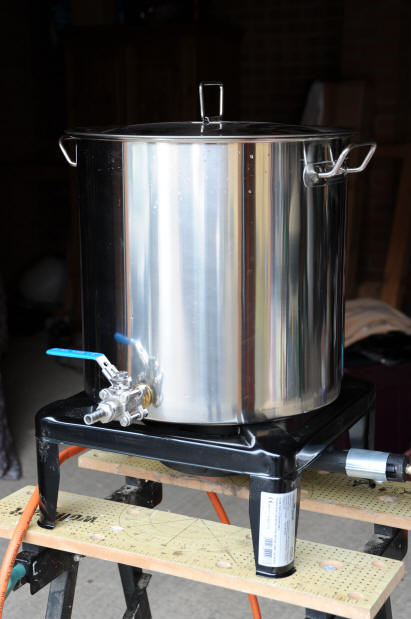
- I am now using a 75L stainless steel pot as a boiler.
- Took about 30 minutes to come to the boil once moved to the garage. I fitted the lid as this seems to speed this process up.
- Once boiling started the lid was removed and the first batch of hops added. The lid was put back on but only partially leaving a large gap to ensure the nasties were boiled off.
- Timer set for 1 hour 30 minutes.
- Using the gas gives much more control and allows me to set the rolling boil without overcooking it.
- Nearing the last 15 minutes, so I have put the Wort chiller into the boiling wort. This ensures that it is fully sterlilised.
- The second batch of hops was added for last 10 minutes together with the protofloc tablet.
- After the full 1 hour 30 minutes the boiler was switched off and the final batch of hops was added.
- The cooler was connected up and started.
- Measured SG and got a reading of 11.5 Brix 1046. This is a little low but I think i have slightly more volume than intended
Cooling
- Connected up the garden hose pipe to the wort chiller and started the cooling process.
- The cooling coil was suspended so it was only just below the surface. This ensures that the top part of the wort cools.
- After about 40 minutes the wort was below 30c.
- The cold break was not as visible as normal but this may be due to the mains water temperature not being that cold during the summer. This works better in the winter when the mains water is very cold.
- After around 1 hour the wort was below 30C so run off was started.
Draining/Aeration:
- The first 3 litres of wort were tipped back into the boiler as they had grain husks in them.
- Once it started to pour without any bits, it was left to drain slowly.
- The wort was very clear and a beautiful golden colour. Very little trub was extracted from the boiler.
- In order to be able to move 40L of wort I used a wine fermenters to collect the run off. These are then only 20L each and can easily be moved back inside the house.
- I had about 2 feet of tube attached to the boiler tap, which creates a siphon effect to ensure all wort can be extracted.
- There was some wastage, mainly wet hops and a little murky wort. I am now using a 75L SS pot, which is quite wide and flat, so the wastage is slightly higer. (750ml max).
- During the draining, the wort also got a good aeration.
- A 50L pot was cleaned and sterilised ready for use as a fermenter. This was set up on a heat pad and connected to a maxi chiller with the temperature controller managing the temperature. I have put the probe straight into the pot as this is a stainless steel 200mm version.
- The final volume was in excess of 40L
Fermentation:
- The wort was around the 25C mark, so safe for yeast pitching.
- I did not make a yeast starter as I have had trouble with these in the past, so just sprinkled the yeast on top of the wort as suggested on the packet.
- I left the yeast on top of the wort for around 20 minutes to re-hydrate and then stirred in.
- 24/08 16:20 - Yeast stirred into wort. Temperature = 24C
- 24/08 17:00 - Temperature = 20C
- 24/08 19:00 - Temperature is now 18C. I am not sure how long it has taken to get to 18C as i have been out.
- 24/08 23:00 - Looks like a few bubbles are beginning to rise. Temperature is stable at 18.4C
- 25/08 09:00 - Fermentation has started and around 1" of Krausen has formed.
- 25/08 10:00 - Fermentation is now well under way and has started to generate heat. My chiller has now kicked in to maintain the 18C required for a clean ferment.
- 25/08 22:00 - Fermentation is chugging along well with around 5cm of Krausen. The top of the Krausen is very clean and only a small amount of trub/dark brown foam is evident. The temperature is stable at 18C.
- 26/08 - Fermentation continued with a thick Krausen.
- 27/08 08:00 - The Krausen has now dropped back into the wort, so fermentation is slowing down.
- 01/09 - The beer was transferred to wine fermenters and an airlock added.The beer will remain in these vessels for 1-2 weeks to clear. The beer was already clearing well and fermentation looked to be finished. A refractometer reading of 5.8 was recorded, which equates to around 1010 sg although this is only an estimate. The beer already tasted great, so it should condition well.
Kegging:
- 2 Kegs were cleaned with Oxy Clean and then sterilised with iodophor. I also rinsed the iodophor out with some boiled water.
- 5 X 500ml bottles were also sterlised with VWP.
- The bottles were filled first as this is much easier than trying to avoid yeast and fill bottles at the same time.
- Both Kegs filled, gassed and purged several times.
- Gas was set to 30 psi and one keg was shaken for 5 minutes to carbonate slightly. This was only because I wanted to start drinking from the first keg. The pressure was then set at 15psi.
- 15 psi proved to be a little low and the beer tasted flat. This is mainly due to the unseasonal warm temperatures in late Sept. Moving the psi to 20 has resolved this.
Tasting Notes:
A very clean tasting, easy drinkable drinkable beer with a soft malty flavor. It is not completely clear at the moment (very slight haze) but this because it is fresh in the keg and has not had time to age yet. Once the beer has aged a little I will sample again.
This brew has now been in the Keg for 2 weeks. The Hop flavour is fantastic and leaves a very subtle after taste considering this has a high IBU. There are no overly astringent bitter flavours, which makes this brew very drinkable. Overall, the beer has a very light easy drinking taste and all of the flavours are well balanced. Mouth feel is good and the carbonation level achieved with 20 psi is perfect.
The only small issue with this brew is that it has remained slightly hazy. This must be due to the Marris Otter that I was using up, which is not as fresh as it could have been. It still tastes great, so I can ignore a little haze.
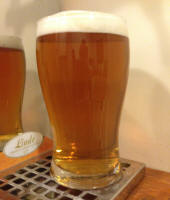
This brew did finally clear but it has taken a lot longer than normal. It now looks and tastes great but I have already drunk most of it.
Contacts
Visit us on Facebook or Email