
SBB Porter
Started 4th November 2014
Whilst in Nottingham a couple of years ago, I was lucky enough to spend an evening in the "Ye Olde Trip To Jerusalem" pub. This pub is claimed to be the oldest pub in the UK and it certainly has some history. The pub has its own beer, the "Olde Trip" ale, that was sampled in some quantity. This beer was very smooth, full of flavour and is a bit like a Mild but with fuller hops. Since then I have been trying to find a clone recipe for this beer but have been unsuccessful. This recipe is a guess at the kind of brew that will give the toffee / fruity tastes found in the "Olde Trip". What I have ended up with is closer to a Porter style, so may not be exactly what I was looking for but will still be a tasty brew.
I will use liquid yeast for this beer as the attenuation is lower than S-04, this should leave some residual sweetness. The grist will consist of Pale, Crystal and Chocolate Malts plus Rolled Oats for body.
Recipe
Ingredients:
| Recipe | Measure | |
|---|---|---|
| Pale Malt (EBC 4 or less) | 8100g 83% |
 |
| Crystal Malt | 980g 10% | |
| Chocolate Malt | 484g 5% | |
| Rolled Oats (Quaker) | 210g 2% | |
| Fuggles (90 Min) | 100g | |
| Goldings Hops (Last 10 Min) | 22g | |
| Yeast | WLP002 | |
| Mash Liquor | 24.4 Litres | |
| Strike Heat | 72C | |
| Mash Temperature | 66C | |
| Mash Time | 1 Hour 30 Minutes | |
| Sparge Temperature | 77C | |
| Mash Efficiency (estimated) | 70% | |
| Boil Time | 1 Hour 30 Minutes | |
| Batch Volume | 40 Litres | |
| Fermentation Temperature | 18C | |
| IBU | 26-30 | |
| Expected OG | 1050 | |
| Actual OG (Note Final volume = 41.5L) | 1056 | |
| Expected FG | 1015 | |
| Actual FG | 1014 |
Water Treatment:
As this brew is a darker Porter style, we do not need to reduce the CaC03 levels quite so much as you would with a light beer. For a porter the levels should be between 100-150, so we will aim for 125. Calcium levels should be between 100-120ppm
| Recipe | Measure |
|---|---|
| CaCo3 Adjustments | |
| Calcium Carbonate (CAC03) Anglian - Measured with Salifert Kit | 145 ppm |
| Calcium Carbonate Required | 125 ppm |
| Adjustment Necessary | 20 ppm |
| CRS per Litre Required (Not really necessary to adust) | 0.5ml per 10 ml/L |
| Total CRS to add to Mash - 24.4L | 1 ml |
| Total CRS to add to Top Up - 9.8L | 0 ml |
| Total CRS to add to Batch Sparge - 23.4L | 1 ml |
| Chlorine Treatment | |
| Campden Tablets (half in mash, half in sparge) |
1 tablet |
| Calcium Adjustment (using brupaks calculation) | |
| Calcium in Water (Cac03 X 0.4) | 58 ppm |
| Calcium Required | 110 ppm |
| Adjustment | 52 ppm |
| Gypsum | 1 tsp |
To calculate the water required for the batch sparge, I am using Jims Calculator, see Here. This calculator needs adjusting to your own equipment and on my first attempt I ended up with 5L more than planned, so some further adjustments are required.
The following parameters were used for the water volume calculations:
- Batch Volume = 40L
- Boil Loss = 10%
- loss to hops = 2L
- Total Grain Bill = 9.774 Kg
- Mash Tun Dead Volume = 1L
- Liquor to Grain Ratio = 2.5Kg
This results in the following water requirements:
- Water Required for Mash = 24.4L
- Water Required for Top Up = 9.8L
- Water Required for Second Batch Sparge = 23.4L
Yeast Starter
The White Labs yeasts are designed for direct pitching into a 20L brew. As I am nornally brewing at the 40L volume this would men using 2 slants, if directly pitching. As the liquid yeasts are expensive (£6+), using 2 is not economical. When using S-04, I just chuck 2 packets in, which works well and is still cost effective.
When using dried yeasts such as S-04, I see little benefit to justify making a starter. In fact, you could argue that making a starter introduces addition risk of infections. S-04 is completely bomb proof, can be pitched directly without re-hydration and always starts quickly. The only down side to S-04 is that it can be a little bland and does not add much character of its own.
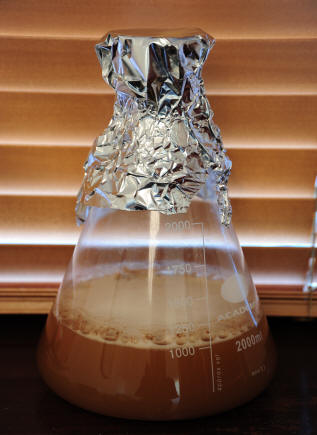
For this brew, I will use WLP002 yeast and will make a 1L starter prior to brew day. A conical flask has bee purchased for this purpose, see picture.
Method:
- Remove liquid yeast from the fridge (allow to rise to room temperature)
- Sterlise all equipment / utensils
- Boil 1L of water in a Saucepan
- Add 1 Cup of DME
- Boil For 10 Min
- Cool as quickly as possible - I put the hot pan in the sink and filled with cold water, changing water frequently
- Transfer to conical flask and pitch yeast
- Cover with sterilise foil - Needs to breath
- Store at room temperature and shake vigorously as often as possible
- Check after 12 hours to see if there are signs of fermentation starting
- After 48 hours transfer flask to the fridge ready for brew day
- On brew day pour most of the liquid in the starter off the yeast
- Allow the yeast to rise to room / pitching temperature
- Swirl flask around to mix yeast with remaining liquid and then pitch into your brew
Mashing:
- 24.4L measured out into HLT.
- The water Hardness was measure with a Salifert kit and is showing around 145 Caco3 ppm. As this is a darker beer the target cac03 level is between 100 and 150 depending on what books you read. I am aiming for around 120ppm, so have added a little CRS but was not strictly necessary. 1/2 Campden tablet was also added.
- Water heated to 78c
- Mash Tun was filled with a few litres of warm water to warm it up a little.
- Mash Tun was filled with 24.5L of water and grain doughed in.
- Temperature settled at 67C, so the timer was set for 1 Hour 30 Minutes.
- It is a little cold outside now, so I have added some extra insulation to the Mash Tun.
- Finishing Mash Temp was just under 65C, which is a little low but this is still OK.
Sparging:
- Top up of 9.8L added at 85C and stirred well. This was left for 15 minutes before draining.
- HLT topped up to the 23.4L Mark and set to 79C.
- Mash tun was fully drained and re-filled from HLT.
- Drained wort was added to the bolier and the boiler switched on.
- A good stir and then leave for 15 Minutes.
- Final batch drained and added to the boiler.
Boiling:
- Gas cylinder ran out during the heating stage, had to nip out and get a refill.
- New gas cylinder achieved a good rolling boil. First batch of hops added.
- After 1 Hour 15 min, the wort chiller was put into the boil.
- Final 10 minutes, 22g of Goldings added.
- Flame out at 1 Hour 30 Min and Immersion Chiller switched on.
- Took about 1 hour to reduce temperature to below 30C.
- SG after boil was 13.8 Brix which equates to 1056. I have also ended up with 41.5 L of wort, which was 1.5L over my target. By adding these figures back into the Beer Engine software, an efficiency of 80% was achieved. Final ABV will be 5.3% and FG should be 1015.
Fermentation:
- The yeast starter was removed from the fridge and the DME carefully poured away. A small amount of DME was retained in the flask to mix the yeast. This is now being warmed to room temperature.
- A Fermentation vessel was hooked up to the Maxi Cooler and a Heating tray. These are both being controlled by an STC1000 set at 18C. I have added some insulation and wrapped in a blanket as this is outside in the Garage.
- The wort was drained from the boiler with a drop of about 1 meter to ensure it was well aerated.
- As the wort was being drained I added a couple of pints to my conical containing the yeast. This is to minimise any shock to the yeast caused by pitching into a large volume of wort..
- The temperature was at 24C, so safe to pitch the yeast.
- 9th Nov - 16:20 - Yeast pitched.
- 10th Nov - 08:00 - Temperature was 17.9c and the heater was on. A small amount of krausen was beginning to form.
- 10th Nov - 16:00 - The temperature is stable at 18C. A 2" thick head of krausen has now formed so fermentation is well underway.
- 11th Nov - 16:00 - Wow this brew has gone nuts, the Krausen has overflowed out of the pot overnight. The Krausen has subsided a little now, so at least my beer is not escaping.Temperature is still stable at 18c, so the WLP002 yeast is really chomping through the sugar now.
- 12th Nov - 16:00 - Surprisingly, fermentation is still going strong with a good amount of Krausen. I will leave for a couple of days before checking again now.
- 14th Nov - Still fermenting but has now slowed down but a decent level of Krausen is still evident.
- 16th Nov - Just bubbles left on top now. The brix reading of 7.9 equates to an SG of 1017 but as these readings are unreliable on fermented wort, I think fermentation is complete. I will leave for a couple more days to ensure that the yeast removes any excess diaceytal and then I will check the clarity. If it is clear enough already, it will go straight into the kegs, if not I will transfer to a secondary fermenter under airlock for a week.
- 19th - Fermentation has finished and the beer is surprisingly clear, so I will not need a secondary. Beer was transferred into 7 Bottles an 2 cornies.
Tasting Notes:
This is a lovely beer, full of flavour and very easy drinking. The end colour is very dark, almost Guinness levels of black. There are toffee and chocolate notes and the mouth feel is good. This beer was taken to a New Years eve party and everyone was surprised at the quality and flavours, even the wine drinkers filled their glasses. Definately one to brew again.
Contacts
Visit us on Facebook or Email