
Fullers ESB 38L
Started 04/11/12
This brew was planned using the Beer Engine software to make a 2 Corny batch. ESB is essentially a stronger version of London Pride and uses the same yeast. My previous brew was London Pride using WLP002 Yeast, which was harvested and refrigerated ready for this brew. I will be attempting to re-pitch the yeast that was collected from the London Pride fermentation vessel, fingers crossed that this works.
Recipe
Ingredients:

| Recipe | Measure |
|---|---|
| Brew Length | 38L |
| Pale Malt (EBC 4 or less) | 8359g |
| Crystal Malt | 826g |
| Challenger Hops (Start of Boil) | 14g |
| Northdown Hops (Start of Boil) | 14g |
| Target Hops (Start of Boil) | 28g |
| Goldings Hops (Last 10 Min) | 19g |
| Yeast | WLP002 |
| Mash Liquor | 23 Litres |
| Strike Heat | 72C |
| Mash Temperature | 66C |
| Mash Time | 1 Hour 30 Minutes |
| Sparge Temperature | 77C |
| Mash Efficiency (estimated) | 75% |
| Boil Time | 1 Hour 30 Minutes |
| Fermentation Temperature | 20C |
| Expected OG | 1054 |
| Actual OG (Leaking Cooler diluted) | 1049 |
| Expected FG | 1013 |
| Actual FG | 1011 |
Water Treatment:
| Recipe | Measure |
|---|---|
| CaCo3 Adjustments | |
| Calcium Carbonate (CAC03) Anglian | 333 ppm |
| Calcium Carbonate Required | 50 ppm |
| Adjustment Necessary | 283 ppm |
| CRS per Litre Required (Brupacks) | 1.5 ml/L |
| Total CRS to add to Mash (23L) | 34 ml |
| Total CRS to add to Sparge- Can Only got 28L in HLT | 40 ml |
| Chlorine Treatment | |
| Campden Tablets (half in mash, half in sparge) |
1 tablet |
| Calcium Adjustment (using brupaks calculation) | |
| Calcium in Water | 133.2 ppm |
| Calcium Required | 180 ppm |
| Adjustment | 53 ppm |
| DLS (using GW Calc it suggests adding none) | None Added |
New Ingredients used
- Liquid Yeast - WLP002 - This yeast was harvested from my previous brew. I have not done this before so I have 2 packs of S04 on standby.
Mashing
- The night before my brew day I filled my HLT with 23L of water ready for the brew day.
- Half a crushed campden tablet and 34ml CRS was added in the morning, to treat the water.
- 08:00 - Switched on HLT to heat Mash water (liquor) to 78C. It took about 45 minutes to get to 78C.
- Filled Mash tun with warm water to heat it ready for Mash Liquor.
- Weighed out grain in a separate bucket.
- 09:40 - Transferred water into the Mash Tun and closed lid for 10 minutes for temperature to stabalise.
- After 10 minutes the temperature was 72C, so doughed in. Grain was given a good stir and then the lid shut with thermometer in place.
- Temperature settled at almost exactly 67C. At this point the lid was sealed properly and some extra insulation added to the mash tun.
- Refilled the HLT with sparge water and switched on to ensure sparge water was ready. Temperature was set to 85C, which allows for some cooling as the water runs through the sparge arm.
- Sparge water was also treated with half a campden tablet and 40 ml of CRS.
- The Sparge water was up to temperature with about 10 minutes to spare before the end of the mash.
- Checked Mash temperature with 10 minutes to go, not sure why as it would be too late to do anything about it but I could not help myself. Temperature was exactly 66C so happy now :) Mash finished at perfect temperature.
Sparging
- Sparging should be done at around 77c but by the time that the sparge water hits the grain it will have lost some temperature. I am aiming to keep the sparge water at 85C to take account of this.
- I will be using the fly mashing method using my "Phils Rotating Sparger"
- Sparge water was heated to 85C in HLT using temperature controller to maintain the temperature at 85C.
- I am using a 3 tier set-up with sparge water at the top, then mash tun, then boiler at the bottom.
- The Wort will be collected in batches as the full 40L is too heavy to move. These batches will be transported into the garage where my boiler is waiting.
- The first 2 litres of run off were returned to the mash tun as they contained trub.
- After collection of about 2 gallons, the wort was taken out to the boiler and the gas ring turned on to full.
- In total I have about 8 Gallons to move so this was done in about 4 loads of 2 gallons which worked well.
- Run off into the collection bins was balanced with sparge water being added for about 2/3 of the brew length.
- I then slowed down the sparge and let the mash tun empty.
- As my HLT is not big enough I topped up with about 4 kettles of water during the process. This time I have over sparged and ended up with more wort than required. The final runnings were above 1015 but I have collected more than enough wort so will stop.
- Sparging took just over an hour in total.
Boiling
- I had collected more wort than would fit the boiler so I have filled it as full as I dare and kept the remainder aside.
- Once the boil has evaporated some of the wort I will add this back.
- As long as all of the wort gets an hour in the boil it should be fine.
- Took about 40 minutes to come to the boil once moved to the garage. I fitted the lid as this seems to speed this process up. Once boiling started the lid was removed and the first batch of hops added.
- Timer set for 1 hour 30 minutes.
- Using the gas gives much more control and allows me to set the rolling boil without overcooking it.
- After about 25 minutes the volume in the boiler had already dropped so I started to slowly add the extra wort. This then got at least 1 hour of boiling.
- The hot break was evident, so a god boil was achieved.
- Nearing the last 15 minutes, so I have put the Wort chiller into the boiling wort. This ensures that it is fully sterlilised.
- The second batch of hops was added for last 10 minutes together with the protofloc tablet.
- After the full 1 hour 30 minutes the boiler was switched off and started cooler.
- Measured SG and got a reading of 13.3 Brix 1053 . This is just below the expected value, I think that I have collected too much wort so my final volume is slightly above expectations. This is OK as it is very close to the expected value and I have more beer. Efficiency was around 75% but if I factor in the additional volume it would be higher.
Cooling
- Connected up the garden hose pipe to the wort chiller and started the cooling process.
- Used some wood to prop up the chiller so it sits at the top of the wort, just below the surface. This makes cooling more efficient.
- When the temperature reached 80C I stopped the cooling and added a handful of goldings hope for aroma.
- After a 15 minute rest at this temperature cooling continued and I went to get a sandwhich.
- Disaster - the immersion cooler "in" pipe has been leaking. The boiler is full to the brim PANIC!!! Ok deep breaths, switched cooling water off and started draining beer from boiler. Hopefully it will be OK, just a little weaker than intended.
Draining/Aeration
- The first runnings had some bits but not too bad, 3 litres was returned to the boiler.
- The wort was then running clear, so collection started into a 5 gallon wine fermenter,
- The colour looks nice but not as dark as ESB should be.
- Drained into the wine fermenters but as I now have close to 50L, I will not be able to ferment in the stainless steel pot. The hop filter did its job well but due to foaming and the wine fermenters being full I had to stop and wait for the foam to subside. When there was more space in the fermenters I was unable to get the flow started again as it was already below the tap. This has led to additional wastage but to be honest I have plenty. During the draining, the wort also got a good aeration. Temperature of the wort was 26C and as WLP002 seems to like a higher start temperature so I will pitch the yeast.
- Final reading for Original Gravity was 12.6 Brix 1050, which is OK given the error.
Fermentation
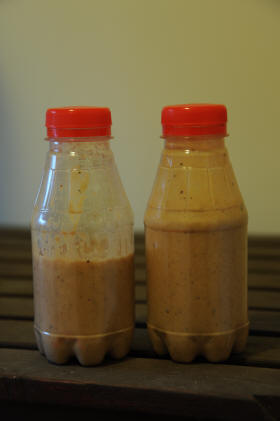
2 bottles of yeast, which had about 200ml of yeast in each were removed from the fridge earlier that day. A little boiled/cooled water was added and the bottles well shaken.
The yeast was tipped directly into the fermentation vessel and well stirred. Not sure how this will work so there are 2 packet of S04 on standby.
- 04/11/12 - 17:00 - Bloody hell, there's bubbles coming from the airlock. Seems that re-pitching yeast is a good way to get things started. I shook the yeast a few times during the day and the bottle kept expanding, so it was raring to go. This was pitched without creating a starter.
- 05/11/12 - 08:00 - Temperature is 20.7C, which is fine. Fermentation is going full steam ahead now and a think Krausen has formed. I have an airlock on one fermenter and it is blowing like crazy.
- 05/11/12 - 16:00 - Temperature is 20.2C, beginning to fall so need to keep a close eye on this now. Krausen has ventured out through the airlock so have rinsed and refilled airlock.
- 06/11/12 - Krausen fallen back into beer. Temperature a little low as I am having to switch fermenters around to get one on the heating tray at a time. a lot of yeast has dropped to the bottom, almost an inch worth.
- 7/11/12 - Fermenting well still, airlock is bubbling away. I swapped the fermenters around again when i got home from work and as the heat raised the temperature in the cooler fermenter large clumps of yeast were rising to the surface then falling back again. The only way I can describe this is like a lava lamp. Not sure if this is good or bad.
- 8/11/12 - Airlock seems to be bubbling once every 2 minutes so I think it has finished. Took a Brix reading and it came out at 6.5, which converts to approx 1011.
- Fitted Airlock to 2nd fermenter and switched off heating. I will leave the beer in the fermenters for another week to clear, although the beer is already fairly clear.
Clearing
- Nothing special required here. Beer was already clear by just leaving in the fermenter under airlock for a week.
- No finings were added.
Kegging
- Due to the problem that I had with my Immersion Cooler there was more than 2 Corny's worth of beer.
- 2 Corny's plus about 12 bottles were all cleaned and sterilised.
- The corny's were pressured to 20psi for around a week to carbonate and then left at this pressure.
- The weather is colder now so they have also been stored at a fairly low temperature in our un-heated utility room.
- Each bottle has around half a teaspoon of sugar added for priming.
Tasting Notes
- When the beer was kegged, a small sample was taken and it tastes very nice, so at least it is not ruined.
- After about 3 weeks in the bottle I have sampled one of the bottles to see how it is conditioning. There is good carbonation level and the beer has a good body and flavour.
- Although this beer was diluted it has a typically ESB taste & flavour. I think this will go down well.
- The head retention does not seem too good but this may be due to the amount of untreated water that ended up being added to my brew. Lack of head retention will not stop me enjoying this beer.
- Based on the OG and FG, I think the final beer ended up around the 4.9% ABV mark, which is a bit puzzling given that I ended up with much more wort than expected. This must be due to better mash efficiency otherwise I would have expected the ABV to be around 4.2%
Final Notes After 12 Weeks Conditioning
I am not sure if this beer has been affected by the dilution error but it cannot have helped. The head retention is still quite poor but the flavour of the beer is OK. This is not a beer I would be rushing to share with my friends but it is still very drinkable. After the London Pride brew in my previous session this beer has a much stronger alcohol taste, which I am not sure that I like so much. I guess it is OK to have a few bottles of ESB hanging around for when you fancy one but as a general quaffing beer I will stick to London Pride.
Contacts
Visit us on Facebook or Email