
Dusty Rafter ESB Mk2 38L
Started 27/11/13
This is my second attempt at this recipe and incorporates a couple of tweaks. The main recipe has been left as per the previous version apart from the Hops/IBU's. As this is quite a malty brew, I decided that the IBU's need to be raised a little. By increasing the amount of Challenger hops, the bittering is raised from 37 to 42.
The ratio of Pale / Crystal malts is 95.4% and 4.6% and Beer Engine was used to check the figures and plan a 38L, 2 Corny batch.
I now have the ability to chill my fermenter, so this time I will ferment around 18-19C and then chill as low as possible to assist clearing.
Recipe
Ingredients:
| Recipe | Measure | |
|---|---|---|
| Brew Length | 38L |
 |
| Pale Malt (EBC 4 or less) | 8760g | |
| Crystal Malt | 426g | |
| Challenger Hops (Start of Boil) | 24g | |
| Northdown Hops (Start of Boil) | 14g | |
| Target Hops (Start of Boil) | 28g | |
| Goldings Hops (Last 10 Min) | 19g | |
| Goldings Hops (at flame out) | 19g | |
| Yeast | S04 X2 | |
| Mash Liquor | 23 Litres | |
| Strike Heat | 72C | |
| Mash Temperature | 66C | |
| Mash Time | 1 Hour 30 Minutes | |
| Sparge Temperature | 77C | |
| Mash Efficiency (estimated) | 75% | |
| Boil Time | 1 Hour 30 Minutes | |
| Fermentation Temperature | 18C | |
| Expected OG | 1054 | |
| Actual OG | 1052 | |
| Expected FG | 1013 | |
| Actual FG | 1012 |
Water Treatment:
| Recipe | Measure |
|---|---|
| CaCo3 Adjustments | |
| Calcium Carbonate (CAC03) Anglian Measured | 194 ppm |
| Calcium Carbonate Required | 30 ppm |
| Adjustment Necessary | 164 ppm |
| CRS per Litre Required | 0.9 ml/L |
| Total CRS to add to Mash (23L) | 23 ml |
| Total CRS to add to Sparge- Can Only got 28L in HLT | 28 ml |
| Chlorine Treatment | |
| Campden Tablets (half in mash, half in sparge) |
1 tablet |
| Calcium Adjustment (using brupaks calculation) | |
| Calcium in Water | 133.2 ppm |
| Calcium Required | 180 ppm |
| Adjustment | 53 ppm |
| DLS (using GW Calc it suggests adding none) | None Added |
Mashing:
- The alkalinity was measured using a Salifert test kit, which gave a reading of 194. This means that 1mm of CRS per L is still about the right amount to use.
- I measured out the 23L of mash liquor the night before and added half a campden tablet to remove chlorine
- Before heating the water I added 23ml of CRS and let it stand for around 10 minutes.
- HLT was switched on and some warm water added to to the mash tun to pre-heat it.
- The Mash water (liquor) was heated to around 78C and transferred into the Mash Tun.
- Temperature dropped quickly to 74C, so I left it for 10 minutes to warm the mash tun further.
- The temperature was now around 73c so a little stirring quickly reduced to 72c.
- Doughed in by slowly adding the grain in steps and stirring. There is over 9Kg of grain, so it needs a good stir to avoid dry pockets.
- The Mash tun was then closed with thermometer in place and left for 5-10 minutes.
- Temperature settled at almost exactly 66C.
- At this point the lid was sealed properly and the glass thermometer was left inside.
- Refilled the HLT with sparge water and switched on to ensure sparge water was ready. Temperature was set to 85C, which allows for some cooling as the water runs through the sparge arm.
- Sparge water was also treated with half a campden tablet and 28 ml of CRS.
- After about 20 minutes the temperature was settled at 66C, so I will now leave the Tun closed for the rest of the mash time.
- Cleaned and sterilised sparging equipment and boiler while waiting. Not forgetting to connect hop filter in the boiler.
- After the Full Mash Time, the temperature was around 65/66C as planned.
Sparging
- Sparging should be done at around 77c but by the time that the sparge water hits the grain it will have lost some temperature. I am aiming to keep the sparge water at 85C to take account of this. I will be using the fly mashing method using my "Phils Rotating Sparger"
- Sparge water was heated to 85C in HLT using temperature controller to maintain the temperature.
- I am using a 3 tier set-up with sparge water at the top, then mash tun, then boiler at the bottom.
- First runnings will be tipped back into the Mash Tun to avoid taking too much grit into the boiler.
- The Wort will be collected in batches as the full 40L is too heavy to move.
- The first batch was collected directly into the stainless steel boiler which was then moved to the garage before becoming too heavy.
- After collection about 2 gallons, the wort was taken out to the garage and the gas ring turned on to full.
- At this point I had to switch everything off as I had run out of time and had an appointment. 40 minutes break.
- Sparge water was reheated / boiler switched back on and sparging continued. I am not sure what effect this will have, it may lower my efficiency.
- I continued sparging until the water ran out as the SG of the runnings was OK. The final measurement was 1010.
- Sparging took just over an hour in total.
Boiling
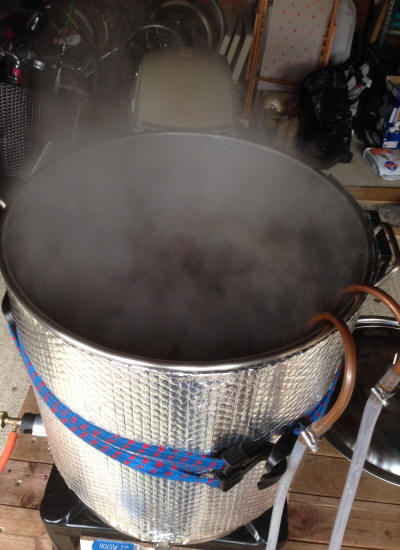
- Took about 30 minutes to come to the boil once all sparged wort was added to the boiler. I fitted the lid as this seems to speed this process up.
- This was boiled in a 70L pot so i now have enough space to get all the wort in without the risk of a boil-over.
- Once boiling started the lid was removed and the first batch of hops added. The lid wa re-fitted but only partially allowing steam to get out easily.
- Timer set for 1 hour 30 minutes.
- Using the gas gives much more control and allows me to set the rolling boil without overcooking it.
- I topped up with the excess wort that I had as space became available in the boiler. All wort got at least 1 hour boil.
- Nearing the last 15 minutes, so I have put the Wort chiller into the boiling wort. This ensures that it is fully sterlilised.
- The second batch of hops was added for last 10 minutes together with the profofloc tablet.
- After the full 1 hour 30 minutes the boiler was switched off and a final batch of Goldings was added.
- The immersion cooler was connected up and started.
- A Brix ready showed 12.8 Brix post boil, which equates to an SG of 1052. This is slightly lower than expected but is probably due to the paused sparge. It is still at an acceptable SG so no worries here.

Cooling
- The Immersion cooler was connected to the hose and started running. At this time of year the mains water is quite cold so it does not take so long to cool.
- After 20 minutes or so I gently stirred the wort and then raised the cooling coil to just breach the surface.
- Cooling took about 45 minutes
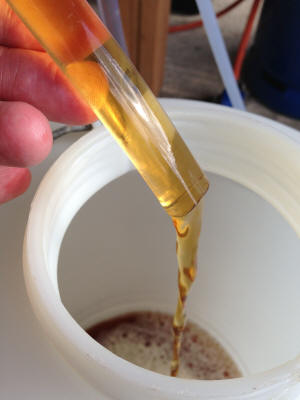
- The wort was extremely clear when run-off, see picture above.


Fermentation:
- Wort temperature is 22.4c, which is perfect for pitching the yeast. I have set the fermentation temperature to 18c
- 27/11 17:00 - 2 Packets of S04 were sprinkled on top of the yeast. After 10 minutes this was stirred in well.
- The temperature controller is runninng the cooler at the moment as it is reducing the wort temperature to 18C
- 27/11 20:00 - The cooler has dropped the wort from 22.4c down to 18c
- 27/11 22:00 - First sign of krausen but only just.
- 28/11 08:00 - The temperature has stabalised at 18.4c, which is just below the point where the cooler will come on. a Good clean Krausen has now formed.
- 28/11 15:30 - Krausen is well established and temperature is at 18.4C and cooler has fired up.
- 28/11 16:00 - Temperature now at 18C
- 28/11 22:00 - Fermentation is well under way and is generating quite a bit of heat now. The cooler has come on 2-3 times in the last 3 hours, which shows that the temperature would have climbed without it.
- 30/11 - The Krausen has now began to subside but is still covering the surface of the wort. Fermentation temperateur has remained steady between 18C and 18.4C.
- 4/12 - Fermentation seems complete, an SG reading of 1012 was measured. I have now raised the temperature to 19C for a day or two to finish off. The temperature will then be dropped to encourage the yeast to drop out.
- Temperature was dropped to 10C for 2 days to get as much yeast as possible to drop out.
Kegging:
- Beer Kegged on Sunday 8th.
- After 2 days at 10c a sample was taken which looked relatively clear. The beer could have been left longer but without an airlock this is not such a good idea.
- Kegs were cleaned with oxy clean and then sterilised with OI Star (iodine). The IO Star is no rinse but I usually rinse with boiling water to be safe.
- The volume of beer in the fermenter exactly filled the 2 corny Kegs.
- Kegs were sealed and gassed to 20 psi. They were then purged several times to ensure that no oxygen remained.
- I have split my gas line so that both Kegs can be gassed at the same time. The kegs will be left alone for 1 week in the utility room which is at around 14c.
- 18/12 - The beer is still slightly cloudy but is almost clear. I think it is better to move the beer into a secondary container under airlock for a couple of weeks to clear but I will wait for the beer to condition properly before making a decision on this.
Tasting Notes:
As this batch has been rushed for Christmas, it has had very little time to condition. First tasting on 18/12, when the beer is still a little cloudy, displayed a strong bitter character. It is too early to say whether this is too much as this may soften with conditioning. Mouth feel is good and the flavour is very clean. I am sure that lots of this will get drunk over Christmas.
OK I have now finished work for Christmas (22nd Dec 2013), so its time to start drinking this brew. It has now cleared well, although not completely. There is a very slight haze but this seems to be rapidly diminishing so this should be clear in the next day or two. Now that the sediment has dropped out the flavour of this brew has really developed well. The sharper bitterness notes have mellowed to a level that is just what I was aiming for. The balance of malt and bitterness is now perfect, so my recipe adjustments have worked well. The S04 yeast has also fermented much cleaner at the 18-19c temperature range.
A very drinkable brew, in my opinion anyway. Lets see what the guests think over Christmas?
Post Christmas thoughts - Well, the beer cleared just in time for the 25th, phew!! It has a beautiful light golden colour and the head retention is perfect, which makes for a great looking beer. There is a lovely smooth malty taste and plenty of mouth feel. The bitterness has developed well and is balanced with the malty flavours without being overpowering. A nice level of after/lingering bitterness rounds off the experience and is very satisfying. I think that this recipe is now spot on and will definitely feature again.
Contacts
Visit us on Facebook or Email