
Dusty Rafter ESB 38L
Started 16/06/13
This brew was based on the Fullers ESB recipe but I have changed the ratio of Pale / Crystal malts to 95.4% and 4.6%. Beer Engine was used to check the figures and plan a 38L 2 Corny batch.
This time I will not be using Liquid yeast as I have been getting very good results from S04, which is cheaper and much easier to handle.
Recipe
Ingredients:
| Recipe | Measure | |
|---|---|---|
| Brew Length | 38L |
 |
| Pale Malt (EBC 4 or less) | 8759g | |
| Crystal Malt | 426g | |
| Challenger Hops (Start of Boil) | 14g | |
| Northdown Hops (Start of Boil) | 14g | |
| Target Hops (Start of Boil) | 28g | |
| Goldings Hops (Last 10 Min) | 19g | |
| Goldings Hops (at flame out) | Handfull? | |
| Yeast | S04 X2 | |
| Mash Liquor | 23 Litres | |
| Strike Heat | 72C | |
| Mash Temperature | 66C | |
| Mash Time | 1 Hour 30 Minutes | |
| Sparge Temperature | 77C | |
| Mash Efficiency (estimated) | 75% | |
| Boil Time | 1 Hour 30 Minutes | |
| Fermentation Temperature | 20C | |
| Expected OG | 1054 | |
| Actual OG | 1054 | |
| Expected FG | 1013 | |
| Actual FG | 1013 |
Water Treatment:
| Recipe | Measure |
|---|---|
| CaCo3 Adjustments | |
| Calcium Carbonate (CAC03) Anglian Measured | 211 ppm |
| Calcium Carbonate Required | 30 ppm |
| Adjustment Necessary | 181 ppm |
| CRS per Litre Required | 1.0 ml/L |
| Total CRS to add to Mash (23L) | 23 ml |
| Total CRS to add to Sparge- Can Only got 28L in HLT | 28 ml |
| Chlorine Treatment | |
| Campden Tablets (half in mash, half in sparge) |
1 tablet |
| Calcium Adjustment (using brupaks calculation) | |
| Calcium in Water | 133.2 ppm |
| Calcium Required | 180 ppm |
| Adjustment | 53 ppm |
| DLS (using GW Calc it suggests adding none) | None Added |
Mashing:
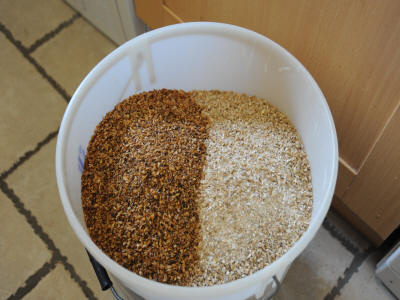
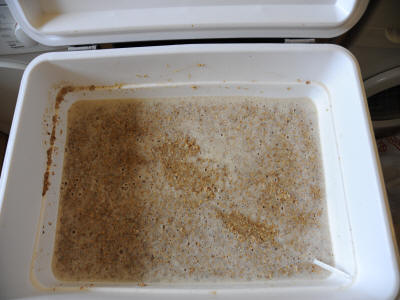
- While water was being heated, half a crushed campden tablet and 23ml CRS were added to treat the water.
- I half filled the mash tun with warm tap water to pre-het it ready for the mash liquor.
- The Mash water (liquor) was heated to around 78C and transferred into the Mash Tun.
- Temperature dropped quickly to 74C, so I left it for 10 minutes to warm the mash tun further.
- The temperature was now around 73c so a little stirring quickly reduced to 72c.
- Doughed in by slowly adding the grain in steps and stirring. There is over 9Kg of grain, so it needs a good stir to avoid dry pockets.
- The Mash tun was then closed with thermometer in place and left for 5-10 minutes.
- Temperature settled at almost exactly 66C.
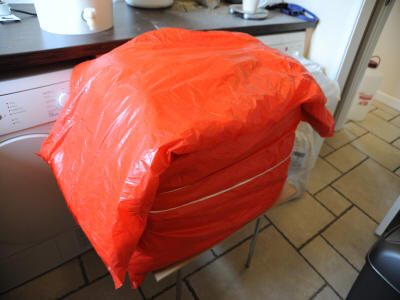
- At this point the lid was sealed properly and the glass thermometer was left inside.
- Refilled the HLT with sparge water and switched on to ensure sparge water was ready. Temperature was set to 85C, which allows for some cooling as the water runs through the sparge arm.
- Sparge water was also treated with half a campden tablet and 28 ml of CRS.
- After about 40 minutes the temperature was 67C, so I will now leave the Tun closed for the rest of the mash time.
- Cleaned and sterilised sparging equipment and boiler while waiting. Not forgetting to connect hop filter in the boiler.
- After the Full Mash Time, the temperature was around 66C as planned.My Mash Tun definately holds in temperature better with a larger grain bill.

Sparging
- Sparging should be done at around 77c but by the time that the sparge water hits the grain it will have lost some temperature. I am aiming to keep the sparge water at 85C to take account of this. I will be using the fly mashing method using my "Phils Rotating Sparger"
- Sparge water was heated to 85C in HLT using temperature controller to maintain the temperature.
- I am using a 3 tier set-up with sparge water at the top, then mash tun, then boiler at the bottom.
- First runnings will be tipped back into the Mash Tun to avoid taking too much grit into the boiler.
- The Wort will be collected in batches as the full 40L is too heavy to move.
- The first 2 litres of run off were returned to the mash tun as they contained trub.
- The first batch was collected directly into the stainless steel boiler which was then moved to the garage before becoming too heavy.
- After collection about 2 gallons, the wort was taken out to the garage and the gas ring turned on to full.
- In total I have about 8 Gallons to move so this was done in about 4 loads of 2 gallons which worked well.
- My HLT is a little small so to make up the volume, I boiled a few kettles and gently poured them into the Mash Tun. I think 5 kettles got me to the volume I wanted.
- I continued sparging until the water ran out as the SG of the runnings was OK. The final measurement was 1012.
- Sparging took just over an hour in total.
Boiling
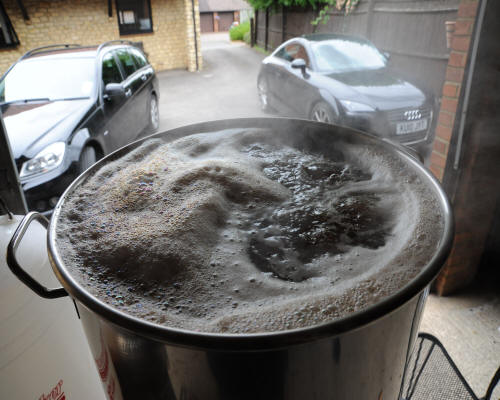
- Took about 30 minutes to come to the boil once all sparged wort was added to the boiler. I fitted the lid as this seems to speed this process up. As you can see, I am very tight for space so the boil has to be watched very closely.
- Once boiling started the lid was removed and the first batch of hops added.
- Timer set for 1 hour 30 minutes.
- Using the gas gives much more control and allows me to set the rolling boil without overcooking it.
- I topped up with the excess wort that I had as space became available in the boiler. All wort got at least 1 hour boil.
- Nearing the last 15 minutes, so I have put the Wort chiller into the boiling wort. This ensures that it is fully sterlilised.
- The second batch of hops was added for last 10 minutes together with the profofloc tablet.
- After the full 1 hour 30 minutes the boiler was switched off and a final handfull of Goldings was added.
- The cooler was connected up and started.
Cooling
- Connected up the garden hose pipe to the wort chiller and started the cooling process.
- The cooling coil was suspended so it was only just below the surface. This ensures that the top part of the wort cools.
- The washing machine had broken down so had to divert my attention while the cooling took place. Luckily the washing machine was fixed by manually draining and then removing hair clips from the water pump service opening.
- After about 40 minutes the wort was below 30c.
- The cold break was now visible and the wort looked crystal clear with clumps of trub forming.
- A further 15 minutes and it was around 24C, so 10 minutes more should do it.
Draining/Aeration:
- The cooled Wort was Slowly drained into another bucket. Even the first litre drained was clear but had a few bits of grain husk so was tipped back into the boiler.
- Once it started to pour without any bits, it was left to drain slowly.
- Very little trub was extracted from the boiler.
- In order to be able to move 40L of wort I used 2 wine fermenters to collect the run off. These are then only 20L each and can easily be moved back inside the house.
- I had about 2 feet of tube attached to the boiler tap, which creates a siphon effect to ensure all wort can be extracted.
- The flow rate was excellent and filtered well right down to the bottom of the pot.
- There was very little wastage, mainly wet hops and a little murky wort (500ml maybe).
- During the draining, the wort also got a good aeration.
- The 50L boiling pot was then cleaned and re-sterilised ready for use as a fermenter. This was set up on a heat pad with the temperature controller managing the heating. I have put the probe straight into the pot as this is now my new stainless steel 200mm version.
- The two wine fermenters were then emptied into the 50L stainless steel pot giving a good aeration.
Fermentation:
- The OG brix reading was 13.4 which is around 1054 SG, so on target.
- The wort was around the 22C mark, so safe for yeast pitching.
- I did not make a yeast starter as I have had trouble with these in the past, so just sprinkled the yeast on top of the wort as suggested on the packet.
- 16/06 18:45 - I left the yeast on top of the wort for around 20 minutes to re-hydrate and then stirred in.
- 16/06 20:15 - No signs of any action just yet.
- 17/06 08:00 - Fermentation has started and Krausen is 1 cm or so thick.
- 17/06 15:30 - Krausen is now 2" thick and fermentation is going well. The temperature has risen to just under 24c so I need to take some action to reduce this.
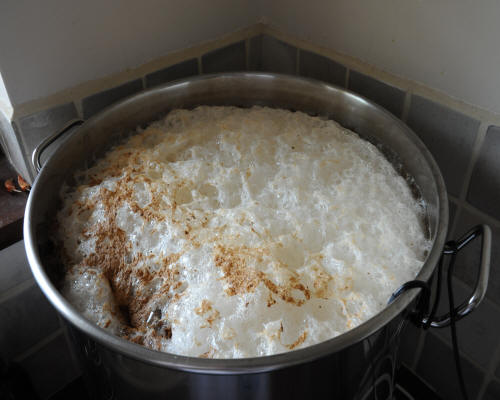

- I have soaked a towel in water and bungeed it to the fermenter. This should help keep the temperature down as it evapourates. As you can see from the photo, 23.8c, so hopefully it will start falling.
- 18/06 08:00 - Fermentation is already slowing down so this brew is going at record pace. The temperature is now 20.8c, so this has stabalised. Krausen has reduced to a thin layer.
- 18/06 17:00 - Krausen has now fallen back into the beer but i can see bubbles rising so it has not finished yet. the temperature is now at 20.6c and stable. I will take an SG reading tomorrow to record progress.
- 19/06 20:00 - I think fermentation has finished, there are very few bubbles rising now. I want to leave the beer on the yeast for a day or two more as it will be cleaning up the Diacetyl. I have also taken a Brix reading to get an idea of what stage we are at and it has shown as 6.9 Brix. This equates to around an SG of 1012-1013, which is where my final gravity was expected to be. I will move to a secondary fermenter under airlock on Friday evening. The beer will then be left for one further week to clear.
- 20/06 - Nothing particularly special to report.
- 21/06 - Transferring beer into wine fermenters so that I can fit an airlock. Beer will now be left for 1 more week to clear as much as possible before kegging.
Clearing:
- Due to lack of spare time the beer was left in teh wine fermenters for around 10 further days before I could get it bottled / Kegged
- No special treatment was added and the beer has cleared perfectly.
Kegging:
- For the first time I am going to be using some Mini Kegs. I am not sure how this will work out but we will find out shortly.
- This batch will be transferred into 1 Corny, 3 mini Kegs and several bottles.
- All kegs were cleaned with a solution of Oxy Clean and then Sterilised with IO Star.
- Although IO Star is no rinse in the correct ppm I take no risks and always rinse with boiled water.
- As the Mini Kegs will not be gassed with C02 the need to be primed with sugar in the same way as the bottles. I would normally put 1/4-1/2 a tsp of sugar in a 500ml bottles so this would equate to around 5 tsp for a 5L Mini Keg. As I was a bit nervous on how much pressure they would withstand I only used around 3tsp.
- Beer was transferred to the Corny which was then sealed and gassed up to 20psi. I purged the Keg around 4 times overt the period of an our to get all the oxygen out. The Keg was then left for a few days to carbonate.
- After filling the Mini Kegs and bottles I added the sugar just prior to capping/sealing. It may be due to the warm weather but both the Mini Keg and bottles immediately frothed up and overspilled. This led to some rapid panic capping to avoid loosing beer.
Tasting Notes:
First Crafty Taste
The colour is quite dark considering I used less Crystal Malt than usual but still a pleasing colour. The beer has a very smooth malty taste with a nice sweet after taste. Given the final gravity, I was quite surprised how much residual sweetness had remained in the beer. The hop flavour is good and is not overly bitter in taste. Considering that this is quite a strong beer (5.4%), it is very smooth tasting. Hopefully this will condition well and become a cracker.
After Conditioning
This beer just keeps on improving with time. It is a lovely light golden colour and very smooth to drink. There is plenty of mouth feel and a nice residual sweetness. The hop flavours are quite mellow but still very satisfying. A great beer!
The only are that this beer seems to lack is bitterness but this may be my personal taste. The recipe indicated an EBU of 37 in the Beer Engine software but the high residual sweetness needs to be complimented by a stronger bitter flavour. I am going to brew this again as it is a cracking beer but next time I will raise the Challenger Hop bill to bring the IBU closer to 40
Contacts
Visit us on Facebook or Email